Fiction: Go Inside
Fiction by Gordon Hopkins
One
Billy sat outside Principal’s Strack office. It wasn’t the first time.
Billy wasn’t a bad kid. He wasn’t even an especially contrary kid. He just wasn’t good at playing “the game.” The game that all kids have to play when adults make rules that kids must at least pretend to follow, no matter how dumb they are.
Cold from the molded plastic of the chair radiated through the seat of his pants and made him squirm. Why was it always so cold outside Strack’s office, no matter what time of the year? Billy was taller than most of the ten-year-olds in his class and his feet could touch the floor.
The door was closed but Billy could still hear what Strack (Sad Strack, as most of the school kids called him) said to his parents. Every word that came out of the principal’s mouth seemed to be at least ten decibels louder than necessary or appropriate. His folks weren’t that bad, but they weren’t exactly quiet talkers, either.
Billy heard Strack say, in the most officious voice possible, “We caught your son reading during class, again.”
“Isn’t that what he’s supposed to be doing?” asked Dad reasonably.
“Not his assigned reading.” Strack responded. “Miss Lipstein caught him doing it before and moved him to the front of the class. It didn’t stop him. He held the book under his desk, trying to keep her from seeing what he’s doing. He wasn’t paying attention to today’s lecture at all”
Dad asked, “Just out of curiosity, what was his assigned reading?”
“’Silas Marner’,” said Strack.
“Jesus H. Christ!” Dad snapped. “No wonder kids don’t read anymore. Why don’t you people give these kids something to read they might actually like?”
“That’s not really the point,” stammered Strack. His officiousness slipped somewhat.
“Isn’t he passing the class?” Dad asked. “In fact, I’m pretty sure he got an “A” on his last test. And the ones before that. So, what’s the problem?”
“Again, that’s not really the point.” Strack’s voice strained, unaccustomed as he was to anything less than total subservience. “It’s the curriculum.”
“Well, you can take your curriculum…” Dad began but was cut off by Mom.
“We’re very sorry about this, Mr. Strack. We’ll talk to the boy,” said Mom. “It won’t happen again.”
Mom added in a voice equally officious, as if she knew her son could hear her, “I guarantee it.”
Billy could hear the chairs in the principal’s office squeak, meaning his folks were standing up and getting ready to leave. Mom asked, “What was he reading, anyway?”
Billy assumed Strack showed her the book because the next thing she said was, “Ugh!”
Two
Billy pulled his coat closed as he stepped outside the school building and into the chilly October air. Mom waited until they were outside before she laid into him.
“Are you trying to embarrass me?” she demanded as they crossed the parking lot to the family car. “Or are you deliberately trying to get kicked out of school?”
“I’m passing all my classes, with good grades,” said Billy, confidently. He was a firm believer in Dad’s philosophy, ‘I don’t care how the job gets done, as long as it gets done.’
Dad said that all the time. Billy believed it should apply to school work as well, but Mom disagreed. In her mind, it wasn’t enough to get the job done. You had to do the job the right way. She believed in rules for rules’ sake, just like school.
“Good grades aren’t enough,” Mom said, shifting with ease into lecture mode. “School is supposed to teach you how to function in society. You have to follow the rules. How are you supposed to function in society if you can’t follow the rules?”
Billy knew it was a dumb thing to say but he just couldn’t resist, “Actually, I was thinking about becoming a hermit.”
Dad cuffed him lightly on the back of the head. Not enough to hurt but enough to get his attention. He said, “Don’t sass your mom, boy.”
Billy knew, deep down, Dad was on his side, but he also knew he would never show it. Dad liked to say, “I know which side my bread is buttered on, and yer mom has the butter knife.”
Billy never really understood what that was supposed to mean.
As the family climbed into the car, Billy asked from the back seat, “Can I have my book back?”
“I don’t like you reading this junk. I think is warps young minds,” said Mom, not for the first time. She made no move to hand the book over to her son. The title was “The Colour Out of Space” by H.P. Lovecraft and the cover featured an eyeless skull dripping with what was supposed to be blood, but the cover was so sun-faded it was pink, rather than red. The skull looked like it was covered with Strawberry Quik.
Mom continued, “I think maybe junk like this is what makes you the way you are.”
Billy said, smugly, “You mean, smart?”
Dad snorted and, with a smirk, said to his son, “Boy, you just can’t stop being a smartass sometimes, can you?”
Billy said, smugly, “Nope.”
“Obviously, talking to you isn’t enough,” said Mom in her ‘officially exasperated’ voice. “Maybe some punishment will get through to you. Maybe you need to stay home tomorrow night.”
For the first time, Billy ‘s smug veneer slipped, “But tomorrow’s Halloween.”
There was a long pause while Mom said nothing.
“I won’t do it again, I promise,” Billy said in his most pathetically pleading voice, added, “Pleeeeaaaaase.”
His folks looked at each other as Dad started the car.
Finally, Mom relented, “It better not happen again.”
“It won’t. I promise,” said Billy with relief. Another bullet dodged.
They rode in silence for about three minutes when Billy asked, tentatively, “Can I have my book back now?”
Mom said, “I don’t like you reading this junk.”
“Oh, fer chrissake, Cheryl!” barked Dad, apparently forgetting his bread and butter for the moment. “The world is full of kids that won’t read. We got one of the few that actually wants to read. As long as the book don’t got a picture of a naked broad on the cover, I say, let him read it.”
“Fine,” said Mom, tossing the book into the back seat. “But don’t be surprised if our son becomes a serial killer.”
“Our boy is too smart to be a serial killer,” said Dad. “The hours are long and the money is terrible.”
Three
Halloween was Billy’s favorite time of year. At least, it became his favorite time of year when his family moved to this little town two years ago. Before that, they lived in Omaha and Mom refused to let him trick or treat. Dad either agreed or was too concerned about his bread and butter to argue. To hear his parents tell it, Omaha was a horror show filled with drugs and kidnappers and chocolate bars with razor blades hidden inside.
Was it really like that? Billy didn’t know. He’d never been left alone long enough to find out.
This little town was different. This town with only one grocery store and only one traffic light, installed ten years ago and people still complain about it. At least, his folks thought it was different. They let him ride his bike around town and didn’t send the cops looking for his if he was more than two minutes late.
Best of all, they let him go trick-or-treating on Halloween.
Billy and his friends agreed on no store-bought costumes this year. No lame plastic jumpsuits with vacuum-formed masks held on with a tiny piece of elastic guaranteed to break within the first ten minutes on your face. Nope. They would make their own costumes and they would be way cooler than anyone else’s.
None of them wore their costumes at school. That was for little kids dressed up like kittens and cowboys. They waited till after school to don their All Hallow’s Eve disguises.
Billy dressed up like a mad doctor. He took the top half of his older brother’s karate uniform (he never went to training anymore, anyway) and liberally added splatters of fake blood. He took goggles from Dad’s workshop and a pair of green rubber gloves Mom wore to protect her manicure while washing dishes. He didn’t need a wig, just a bit of Mom’s mousse to make his longish blonde hair stand up in an appropriately “mad” manner.
He garnished his ensemble with a stethoscope he’d gotten from his late Uncle Howard. Uncle Howard wasn’t a doctor. He was just a hypochondriac.
Thus garbed, Billy headed down the street to meet up with two friends, the only friends he had.
They were not friends in the traditional sense. They were friends by attrition. They gravitated to each other because they had no one else.
First was Fat Stan. All the kids called him Fat Stan. He called himself Fat Stan. He laughed along with the kids who made fat jokes at his expense. He made fat jokes himself and was usually funnier than anything the other kids could come up with. He once found a picture book in the library called “Flat Staney.” He blacked out the “l” with a marker and announced to the room, “Hey! They wrote a book about me!”
None of the kids, including Billy, knew Stan went home after school, locked himself in his room and cried nearly every night.
When Stan told Billy his costume would be a robot made out of cardboard boxes painted silver, he thought it would be lame. When Billy saw it, he had to admit, it came out pretty good. There were blinking lights on the chest plate and the wheels that poked out under his silver, boxy feet were roller skates. Billy didn‘t ever recall seeing Stan on skates before and wondered if he was going to have a problem staying upright all night.
The two boys then stopped in front of Michael’s house. He was already outside, waiting for his comrades. He was dressed like a pirate, with a hook poking out from one sleeve of a fancy jacket, blue with two rows gold buttons and epilates. Billy recognized it from the previous years’ school pageant where a bunch of kids had to dress up as past presidents. Michael was George Washington.
Michael was very quiet when he was around anyone other than Billy and Stan. A lot of kids didn’t like him because they thought he was stuck up. In reality, Michael didn’t talk much because he didn’t trust himself not to explode when he was angry, which was much of the time.
The reasons for his anger were not evidence to anyone outside his own family. His father always made sure the bruises were hidden under his clothes.
Once the three boys were together, they forgot about their problems and their families and reveled in their anonymity.
Four
Could tonight be the night? It had been so long. So very long.
Five
The boys started at one end of town, with the sun still a tiny bit above the horizon, turning the sky orange and the few clouds overhead pink. They had a fine time, demanding treats and threatening tricks.
They hit every house with a burning porch light. That was the rule. If the porch light was on, there was a bowl of candy waiting. If the light was out, theoretically, that house was fair game for whatever juvenile justice trick-or-treaters should choose to mete out.
The boys were more mischievous than malevolent. They didn’t go in for breaking windows or throwing eggs, and TP’ing houses was just too much work. They mostly settled for stealing pumpkins from doorsteps and shoving them into mail boxes. This would probably annoy the mailman more than those too cheap to buy a bag of chocolate bars for the neighborhood gremlins.
By the time they reached the other end of town, the sky was black. Clouds had rolled in and no stars were visible. Most of the porchlights had also gone dark.
They’d pulled a record haul this year, their bags stuffed with sugar-ladened offerings. There was literally no place else they could go begging for candy and they really didn’t need any more, anyway. Even Stan agreed.
Still, the boys weren’t quite ready for the night to end.
They found themselves at the very end of town, at the end of Western Avenue, where the street turned into a dirt road and only a single, dark house was visible. There was no candy to be had at that house.
Six
Three. She sensed three of them, but she only wanted one. The others were too damaged. But would the one she wanted go inside?
Seven
The house at the end of Western Avenue sat empty for as long as anyone in town had been alive. That was saying something, given some of the ancient codgers still hanging on in this burg.
There was no reason for it be abandoned other than no one wanted to live at the end of Western Avenue. There were no stories of gruesome murders or ghosts or ancient burial grounds. It was just a bad location.
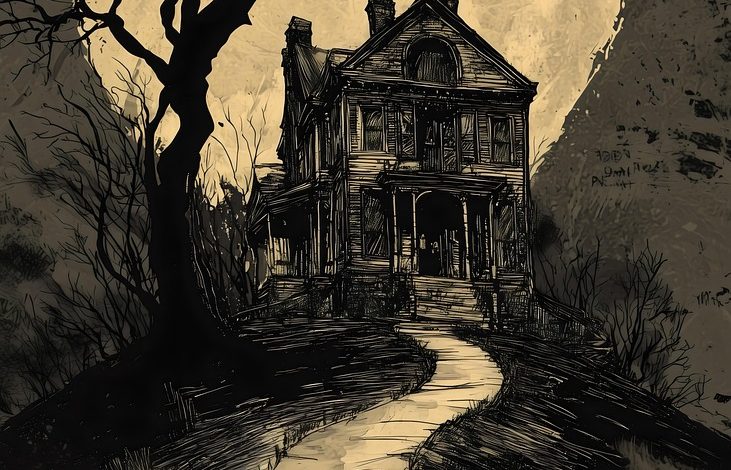
Plus, it was really ugly. It had started off as a small house and over the years (Decades? Centuries? Who knows?) former owners added to the structure with the sole intention of adding more room inside, and without any consideration of how it might look outside. It was an embarrassing, architectural Frankenstein’s Monster. Sitting for so long, it would probably cost a fortune to make livable, even if anyone wanted to live there, which they didn’t.
So, it sat empty.
To a ten-year-old boy, an empty, unexplored space was irresistible. They didn’t even bother with the preliminaries of daring each other and accusing each other of being scared. It was just a matter of deciding who would go inside.
Eight
In her mind, she begged the boy she wanted to go inside. “Please, please, please, please, please!”
Nine
“Well,” demanded Billy. “Are you gonna go inside or what?”
Michael said nothing. Stan said, “Why don’t you go inside?”
“I asked you first,” said Billy.
“No, I asked you first,” said Stan. “So… go inside.”
“Maybe I will,” said Billy.
“Maybe you won’t,” said Stan with a laugh.
Michael said nothing.
“Fine, I will,” said Billy.
Billy stepped carefully through the unkempt weeds, stepping over the few remaining cobblestones that had once been part of the path to the front door.
There was never any doubt he would be the first one inside. His plan was to go all the way through the house and sneak out the back door. Then he would hide out back, waiting for his friends to start wondering what happened to him. They would go inside to find him. Billy wasn’t entirely sure what he would do next but he was pretty sure it would involve sneaking up behind his friends and shouting, “SURPRISE!!!”
Billy reached the front door, pulled it open, stepped inside and pulled the door closed behind him.
Ten
With a sigh of relief, she said to herself, “Finally.”
Eleven
Billy flicked on the flashlight his folks made him take with him and looked around. The room, which assumed to be the living room, was a lot bigger than he expected it to be. A single picture window was boarded up, allowing in no light from the outside. The walls were crusty with gray, peeling paint. Portions of the ceiling had fallen to the floor, revealing the rotten wooden beams holding the upstairs. Small clouds of dust were kicked up as he walked.
Billy went through the door on the other side of the room and went down a long hallway with a rounded ceiling and stone walls. He was surprised at how long it was. He went through the door at the other end of the hallway and into another empty, ruined room. He expected to have reached the kitchen by now. That’s where the back door usually is. Instead, he soon found himself in another hallway, leading to another room, leading to another hallway, leading to another room, leading to another hallway.
Billy started to become confused, and even a little bit panicked. The house couldn’t be this big. How long had he been walking? He wished he had worn the watch given to him last Christmas by his old Aunt Edelpha. (He called her “Aunt Edema” behind her back.)
Finally, not knowing what else to do, Billy turned back. Once again, he passed through the same room after hallway after room after hallway.
No matter how long he walked, he never seemed to reach the front door.
Twelve
Billy had only been inside a few minutes when Stan and Michael unanimously decided Billy was up to something and followed him. Michael pulled open the front door and both boys were startled to see the entire back of the house was gone, probably fallen in years ago, leaving the entire building expose. The ceiling had also collapsed sometime in they ancient past. There was just an empty space overhead.
From the street, the front of the house was all that was visible. The boys realized the front was the only part still standing. It was literally just a façade.
Thirteen
Others walked through the front door, but that wasn’t the same as going inside. After the other two boys, Billy’ parents came looking for him. Then deputies from the sheriff’s office came. Then came investigators from the state patrol. Then a man from the newspaper came to take pictures of the last place the boy had been seen alive. They all walked through the front door. She wouldn’t let anyone else go inside, however. She had Billy and that was all she wanted for now.
Fourteen
The local newspaper ran a series of stories about the missing boy. It was the most exciting story the paper had published in years. Posters went up around town with Billy’s picture, declaring him “MISSING.” After a few weeks, they were replaced with posters offering a reward. A few weeks after that, new posters doubling the reward.
Law enforcement concluded Billy had either been kidnapped or ran away. They had no leads, apart from the phone call from one well-meaning but utterly mistaken former resident who still subscribed to the paper, convinced she had seen Billy in California at a rock concert.
Eventually, the newspaper moved on to other stories, important and otherwise. Law enforcement insisted the case was still open but still had no leads. Even Billy’s parents, who missed their son desperately, had to accept they couldn’t spend the rest of their lives obsessing over him. After all, they had two other children to take care of. Eventually, they, too, moved on.
No one looking for Billy ever returned to the house at the end of Western Avenue again. Why would they? There was no reason at all to think Billy was still there.
Fifteen
He wouldn’t give up. She could tell. She’d had plenty of experience with little boys like Billy and she knew his type. Eventually, he would realize it was hopeless, that he would never find a way out. Even then, he wouldn’t give up. He would still keep trying to escape out of sheer stubbornness.
He would keep her nourished, and entertained, for many years.
END