Commissioners Want More Time To Review Zoning Regulations
By Gordon Hopkins
While the Jefferson County Board of Commissioners vote to approve the revamped County Comprehensive Plan, they have decided more time is needed to review proposed changes to zoning regulations.
After two years of work, the Planning and Zoning Commission voted to approve the plan and zoning regulations and sent the results to Jefferson County Commissioners for their approval. It is now up to the commissioners to approve the new regulations after making any changes they deem needed. Commissioners have held a series of working sessions, open to the public, to review the proposed zoning changes.
The county hired Marvin Planning Consultants to help update the Comprehensive Plan and zoning regulations and ensure they are consistent and comply with state regulations. John Shepard, senior planner with Marvin, said at the meeting, “Your attorney will advise you, if you make such changes that it no longer resembles what was recommended, you would be required to restart the process, because statute says you can’t adopt something that wasn’t recommended by the board, but you clearly have the option to make amendments.”
However, Shepard also noted, “That’s a qualitative argument.”
The current zoning regulations amount to 68 pages. The proposed version is 215 pages.
Solar Regulations
One of the most contentious issues are those regulations governing industrial solar energy production. There is currently a moratorium on permits for solar facilities in Jefferson County while the zoning regulations are being reviewed.
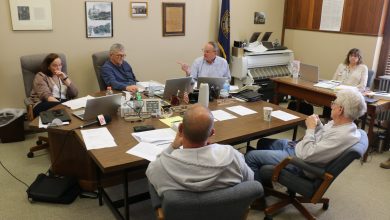
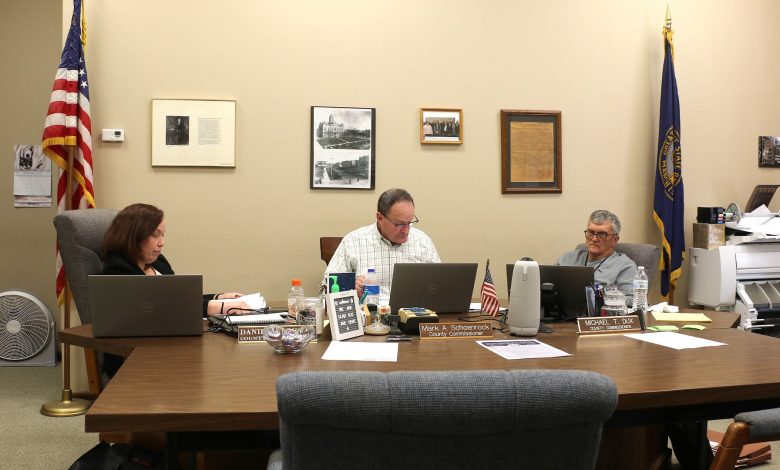
At a meeting of the commissioners on Tuesday, March 24, 2026, Jefferson County Attorney Joseph Casson emphasized the long time commissioners have already spent on the regulations, primarily on solar regulations. “The situation is this. You have spent many, many, many, many, many, many, many, many months reviewing just the solar (regulations) and after that thorough review from the Planning Commission, you have reviewed it many, many, many times and come up with a red line change which is acceptable, in theory, to the board. So, the question today is, should you approve that? And if you don’t approve it as submitted, then I guess we go back to the drawing board and start over again. But it’s time to fish or cut bait, basically.”
Commissioner Michael Dux agreed and made a motion to approve the zoning regulations as amended. That motion failed to pass for lack of a second.
Despite the amount of time that has been spent on the regulations, commissioner Danielle Schwab insisted it is not enough, “I have a hard time with a document that is providing guidance and regulation and land use for the entire county not being looked at thoroughly.”
Prime Farm Ground
One of the sticking points has been the use of prime farm ground for solar energy facilities. Prime farm ground is defined by the USDA (U.S. Department of Agriculture), not by the county.
The Planning and Zoning Commission had recommended allow no more than 10 percent of prime farm ground be allowed for industrial solar energy.
At public hearing in January of this year, some landowners objected that 10 percent was too restrictive and would prohibit any solar energy development. During prior work sessions, commissioners considered changing the restriction to 25 percent.
“To me, it comes down to what percentage of that prime farm ground can be put in the solar. That is the concern that’s been brought to me by my citizens that I represent,” said commissioner Mark Schoenrock. “The way that we have it, we changed the not more than 10 percent of prime farmland to 25 percent, and I think that flies in the face of the interest that’s been brought to me by the people that I represent, so I could not support that 25 percent.”
Schoenrock said he could support the original 10 percent.
Schwab said, “There’s a consistent theme that Jefferson County should be ag first. And it’s not that people are opposed to solar, but they don’t want any kind of large project on farm ground, and so, because of that, I can’t support it as written.”
On the other hand, Dux said, “So, I would say 90-some percent of the citizens in the county want us to broaden our tax base.”
Other Zoning Issues
Schwab felt that the focus on solar was to the exclusion of other zoning issued.
“Well, my concerns are bigger than just the solar,” said Schwab. “We looked at solar, and I don’t feel like we looked at the other enough.”
Schwab said, “We didn’t have one discussion about data centers. We didn’t have one discussion about nuclear.”
No action was taken regarding zoning regulations at the meeting.
The board of commissioners will review the regulations again at a meeting on April 7, 2026.