City Looks To Bring I Street Well Back Into Service
By Gordon Hopkins
Fairbury’s Water Sourcing Committee met Tuesday, July 23, to discuss building a new well house for a long-disused well located on I Street, just north of the Heritage Care Center. The intention is to return the well to operation to provide a lower-nitrate source of water for the city. The total cost is currently unknown but, according to committee chair Brian Schmidt, who also served in the Fairbury City Council, Olsson, an engineering firm the city uses, “indicated it could be between $500,000 and $1,000,000.”
The maximum level of nitrates in public drinking water allowed by the U.S. Environmental Protection Agency (EPA) is supplies at 10 parts per million (ppm).
Construction Schedule
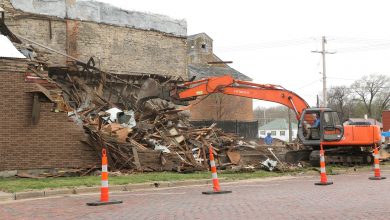
Craig Reinsch, lead engineer for Olsson, was at the meeting via phone. He told the committee, “We are recommending that it’s probably going to be better long-term to knock the thing over and rebuild, primarily because there are a lot of unknowns with the building. It’s 60 years old, we designed well houses differently for lots of other things. And besides, we would have to adjust the roof for the addition of the chemical feed rooms regardless.”
The committee discussed the schedule for construction of the new well house.
“As far as the other construction schedule goes again, looking to have everything bid out and ready for the city council approval by mid-December,” said Reinsch. “And then preliminary construction contracts in January and then we would anticipate that construction start in March when it warms up a little bit, and then we typically plan on six-to-nine months for this kind of building. So, anticipating being done by the end of December of 2025.”
Testing
Water samples were collected in May of this year from the I Street well. Test results indicates the nitrates in the water at 2.8 ppm.
“So, we want to do a down-hole video, okay, so we can confirm that everything’s still okay. If not, then we have to adjust our approach. We would want to run some pump tests. Again, this would be similar to what we would do for a new well, and so my thought and goal would be, if we do them now, including the full water quality scan, and hopefully that saves us some time on the construction part and getting things turned back on,” Curtis Arnold, wastewater superintendent for Fairbury, said.
City Councilperson John Ebke is also on the committee. He expressed concern about the time the project would take, “But I would hate the building to be holding up this stuff. Because honestly, the big deal is that we’ve got some water concerns right now.”
Reinsch explained why he thought the testing was needed, “What the purpose is, we know that the state is going to have a lot of questions about bringing in an older well back into service. So, what we’re trying to do with these tests that we would do, with the exception of the camera, would be required for a new well. And because this sat for so long, I think this would be preemptive. To get ahead of that. To make sure nothing’s going to derail us, right?”
Laura Bedlan, Fairbury’s Development Services Director, expressed concern about putting money into the project before another test of the water is completed.
“We haven’t started our second round of testing yet,” said Bedlan. “If we get that second round of testing that comes back and says, no, this is not going to work, we don’t want to chalk up a bunch of bills.”
Reinsch said, “Well, that is the challenge because that’s the full well scan takes about six-to-eight weeks to get back.”
Schmidt said, “Can’t wait too long.”
Nearby Manhole
However, there is another complication. There is a manhole approximately 40 feet from the well house. According to Wastewater Superintendent Curtis Arnold, “And that’s the start of the sewer for that south side of Circle Drive.”
Arnold also indicated the setback is 100 feet.
“If that is the top of the run, that could be something that we could move so that it’s 100 feet away,” said Arnold. “I don’t know what the depth of that manhole is without investigating further.”
Schmidt asked, “All the rehab we’re doing and all the questions and the sewer possibly a problem, how far away are we, dollars wise and time wise, from just moving over a few feet and drilling a new well?”
While he could not provide solar amount without further research, Reinsch said it would likely cost more to drill a new well. Based on similar projects in other cities, Reinsch said, “By not moving over a couple of feet and drilling and not drilling a new well, you’re basically saving 15 percent of the project, give or take.”
Cost
“We have one bid, and one bid. So this is it’s either take it or leave it,” said Ebke. “I feel like we’re kind of between a rock and a hard place at this point.”
The bid is for the engineering proposal which includes the cost of engineering for the building and chemical injection system, which is just under $2000,000, and not for the entire project.
“I’d realize it’s expensive,” said Ebke. “I mean, we’ve got lots of things that we can live without. I don’t think water or electricity is one. I think if this would ease our burden, maybe not fix it, but ease it for a few years, I think it would.”
Schmidt said, “I agree it and, yeah, it’s not going to be cheap. But we do have grant money to help us out with this. Not all of it, but a portion of it.”