Commissioners Approve Permits For Well Field
By Gordon Hopkins
Jefferson County Commissioners voted to approve the special use permits for two wells on the property of Bill and Mary Glenn, approximately two miles north of Alexandria State Lakes, along with a municipal booster station and ground storage tank.
The wells being proposed are not for private use but instead will provide water to customers of the Little Blue Natural Resources District (LBNRD).
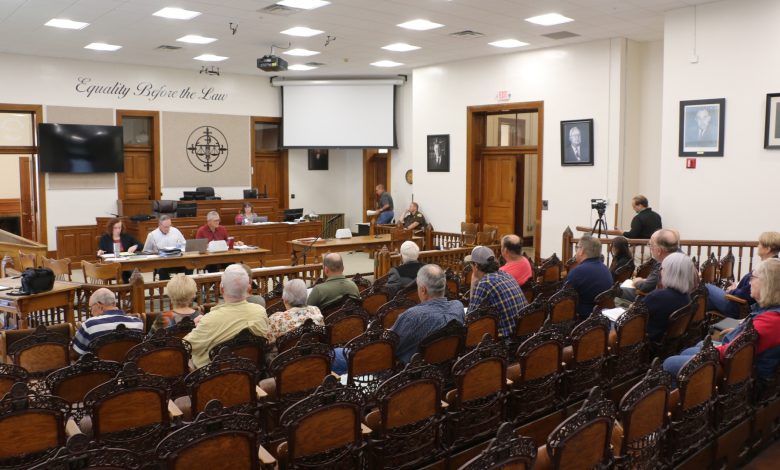
The vote was held the morning of Tuesday, Sept. 2. The meeting was moved upstairs to the courtroom to accommodate the larger than usual crowd expected. More than 25 individuals were in attendance and many took the opportunity to speak out, either for or in opposition to the project. There has been considerable opposition from members of the public who fear the impact on their own wells as well as other environmental factors, such as nitrates.
Much like the Planning and Zoning Commission did at a prior hearing, County Commissioners emphasized they were only reviewing the proposed permits for appropriate land use. They would not be making a determination based on other factors. While those in attendance were allowed to speak about their concerns, commissioner Michael Dux said, “We’ve heard all the testimony. But again, it comes down to whether or not this project is in compliance with our planning and zoning regs.”
Dissenting Vote
The vote was not unanimous. While commissioners Dux and Mark Schoenrock voted to approve the permits, Commissioner Danielle Schwab voted no.
Schwab said, “I agree with Mike. We as commissioners have to look at this as a land use only decision, but our regulations do state that the purpose of our regulations is promoting health, safety, convenience, order, prosperity and welfare of present and future inhabitants of Jefferson County. So, I think that we still have to think about that as well.”
Schwab added, “The comprehensive plan that we’re currently under requires that any public utilities be provided in a way that prevents environment degradation.”
Alternatives Considered
“I had heard that one of the reasons we settled on this site, we had tried for Fairbury and Alexandria,” said Schwab, asking about alternatives. “And it said these were the only landowners willing to work with us. Is this the main reason this site was selected or were stronger aquifer areas studied and rejected?”
“We did get a few interested parties that would talk to us,” said Scott Nelson, LBNRD General Manager. However, he indicated the compensation they wanted was more than the district willing to pay.
In addition, there were objections from the Lower Big Blue NRD. According to Nelson, “Lower Big Blue did come to our board meeting and said, ‘Hell no, you’re not going to use any more water that this targeted area is in our district.’”
LBNRD and the City of Fairbury considered a water project together that would sink five wells in the Glenn property. However, the Fairbury City Council voted against proceeding with the project.
LBNRD also negotiated with Alexandria to purchase water but no agreement was ever reached.
Where the Water Customers are Located
Schwab said, “I had noticed that the Lower Big Blue had a non-transfer clause.”
David Endorf, a landowner who has been a vocal opponent of the proposed project, noted, “There are approximately 25 water users, generally north of town here and east of Highway 15, generally, that are hooked on to the Little Blue water project. This is kind of a sore spot for me, is the fact that Lower Big Blue will not allow one gallon of water to be taken from their aquifer.”
“Yet we as the Little Blue, taxpayers in the Little Blue and water users in the Little Blue, continue to provide water to those 25 users. Now, I’m not saying they should be shut off, but is that right? Is that fair?” said Endorf. “And if you want to take that one step further, this project serves about 58 users in Kansas. Is that right?
Endorf said, “This water is a valuable water resource, and yet, we’re pumping it to Kansas for sale for a few pittance. That is wrong.”
Impact on Neighboring Wells
Representatives from LBNRD have presented findings of hydrology studies and insisted there would be minimal impact on surrounding wells. Despite this, landowners in the area remain worried the new wells could reduce the amount of water available to them from their own wells.
“So, at the last meeting, you said neighbors would need to scientifically prove their well was impacted. And even then, the board might only consider compensation,” said Schwab. “What binding commitments would you be willing to accept on a conditional use permit so that the neighbors aren’t left carrying all that risk?”
Don Blankenau, legal counsel for LBNRD, told the commissioners, “I haven’t spoken to the board yet, so I don’t want to speculate. But in the past, with what projects like this have done, they’ve always offered to enter into agreements with surrounding landowners so that if their wells are adversely impacted, that that can be addressed either by providing an alternate source, drilling their wells deeper, or directly providing water to them. And my expectation would be that this board would entertain something like that as well.”
What Happens Next?
The project is still pending an in-state and out-of-state groundwater transfer permit from the Nebraska Department of Natural Resources in February of 2025. According to Scott Nelson, LBNRD General Manager, they are, “Waiting for their review.”