Meeting In Blue Springs
Discusses Workforce Housing

By Gordon Hopkins
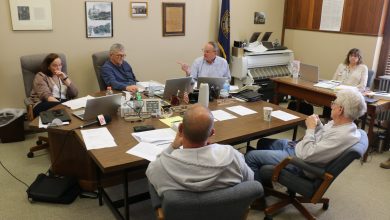
Public officials and civic leaders from Gage County, Nebraska, and Marshall County, Kansas, met at the Blue Springs City Hall Tuesday, August 2, to discuss the ongoing problem of workforce housing.
As the country continues to struggle with a labor shortage, a lack of adequate workforce housing has proven to be an impediment to rural communities trying to attract new workers. In an attempt to address the problem, local community leaders invited City/County Solutions and Hometown Housing, USA, companies that assist communities with housing, to speak about developing and implementing workforce housing.
Clint Fichter, legal counsel for Hometown Housing and himself a onetime small town city manager, attended the meeting via Zoom and said, “What we discovered in our field where work is that people want a job opportunity but they overwhelmingly want to live in rural communities.”
Fichter added, “I see a lot of that, It’s really an opportunity-driven choice.”
According to Shane Gilbert, a home builder with Hometown Housing, the proposed project would consist of two phases, “Our phased in approach: phase one, research; phase two planning and program development.”
Phase one would determine what sort of housing is needed and where and creating a plan.
“The phase one research tells us the finer details,” said Gilbert. “What that mix of property is and what the sizes should be, what the amenities need to look like, how much rent, how much rent-to-own.”
Gilbert said, “We’re not a housing study, we’re a people study. And we’ve worked on understanding what people’s needs are, versus their wants, and what those barriers are.”
The second phase would be the implementing that plan and Gilbert put emphasis on the intention to use local contractors and local businesses wherever possible, “What we do is team build locally, and we’ve got to have local support. And this is not us coming in and doing everything. We’re going to use local resources at every turn. From lenders, to realtors, to builders, to materials, sources, all of those things.”
The cost for a community to participate in the project is $25,000 for phase one and $25,000 for phase two or $40,000 if both are purchased together. There is a guarantee that at least two homes will be built. If that guarantee is not met, then $20,000 will be refunded.
Gilbert acknowledged current economic circumstances might dissuade some investors from participating, “I always say to the communities that sit on the sidelines for the next two to three to five years saying, ‘Well, we’re just going to ride this thing out till the interest rates come back down,’ I think that’s a bad mistake. Because those that do the planning now start preparing for field are going to be the ones that benefit once this thing comes back, as you’re already doing the work.”
The major stumbling block now is money. In July, City/County Solutions and Hometown Housing met with representatives of Jefferson, Saline and Gage counties and Fairbury Mayor Spencer Brown to discuss these same matters. Jefferson County Commissioners are currently looking for possible financing from SENDD (Southeast Nebraska Development District).
Fichter said, “We’ll look at everything that you got going on here and try to find those little leverage points, things that you can do that advance things, construction financing programs, down payment assistance, tax credits, if you have those programs.”
However, Fichter issued a warning, “I try to stay away from federal money at all costs. I’m a huge distruster of the government, federal, and believe that those programs are very niche oriented, and maybe part of a strategy, but a very minor part.”
Fichter added, “hat you’re looking for is, you’re trying to build middle class.”