Planning, Zoning Completes
Review Of Wind Farm Regulations

By Gordon Hopkins
After well over a year of debate and controversy, the finalizing of wind farm regulations in Jefferson County may finally be in sight.
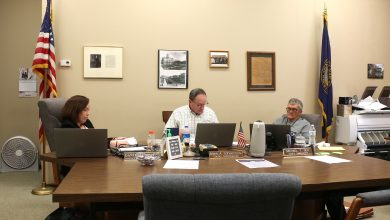
The Jefferson County’s Planning and Zoning (P&Z) Committee has completed its review of regulations regarding the placement of wind turbines in the county at a meeting Thursday evening, February 2, 2023. They will make recommendations to Jefferson County Commissioners regarding setbacks, shadow flicker and decommissioning.
Moratorium
County commissioners first decided to institute a six-month moratorium on wind farm applications September 15, 2021. It was later extended until April of 2023. The purpose of the moratorium was to allow time to review and revise regulations.
Jefferson County is the home of one wind farm, Steele Flats, which consists of 44 turbines in both Jefferson and Gage counties. The facility, owned and operated by NextEra Energy Resources, first went into service November of 2013. Since that time, technology has changed. The maximum height of the turbines at the Steele Flats Wind Farm is 427 feet.
NextEra is looking to build another wind farm in the Plymouth area called Big Blue Wind. Those turbines are expected to be approximately 500 feet.
Setbacks
At a prior meeting on January 26, the P&Z Committee voted to increase the recommended setback for the placing of wind turbines to one mile (5,280 feet). The setback established is measured from the wind turbine to a non-participating landowner’s exterior wall. P&Z also recommended a 1/2 mile setback to the property line of a non-participating landowner’s property.
At the most recent meeting, the committee also voted for a one-mile setback to schools, churches, incorporated communities and state owned recreational areas, such as Rock Creek Station and Alexandria State Park.
The committee opted to add the qualifier “incorporated” to communities, meaning those setbacks would not apply to Gladstone, Powell or Thompson.
A number of people have indicated their preference for greater setbacks. However, others have said increased setbacks could make the placing of wind turbines on certain properties more difficult, or even impossible.
Commissioners have stated the regulations are intended to intended to protect non-participating landowners, not to use the regulations to prohibit the building of new turbines altogether. However, some have suggested a one-mile setback does exactly that.
Others have disputed that claim. A local attorney, Gregory Kratz, spoke at a prior meeting on January 12 of this year, “They (NextEra) might say all these areas are going to be excluded if it’s, you know, a one mile setback from residences. That’s just not the case. It’s not excluded. They may not be able to site, you know, 100 turbines in the area, but they may be able to work with one another to get, you know, one of those, a few of them here, a few of them there.”
Kratz presented a package of proposed regulations to the committee, which included a one-mile setback. He said, “It’s not going to eliminate the possibility of any wind turbines or wind farms going up at all.”
Kratz has not indicated if he is representing himself or if he has a client.
In response, a representative for NextEra told FJN, “The proposed wind turbine regulations presented at last week’s Jefferson County meeting by local counsel Kratz, are incredibly restrictive – essentially making a new renewable energy project unfeasible in the county.
“The proposed regulations discount the property rights of the hundreds of landowners who are or want to participate in a wind farm in Jefferson County. Participating in a wind project is strictly voluntary and offers landowners a great way to diversify their income.”
Local landowners who have the opportunity to lease their land to wind energy companies have also expressed concern. In a letter to the committee, landowner Suzanne Heidemann wrote, “I own or have interest in seven parcels of land in Jefferson or Saline County. None of these parcels lie adjacent to one another so the 1/2 mile setback from the property line of non-participants would eliminate any wind towers on my land and definitely violates my landowner rights.”
At a recent meeting of the commissioners, county commissioner Gale Pohlmann suggested that a one-mile setback makes reviewing the other regulations unnecessary, “In my opinion, they can leave everything else, because we won’t have any windmills.”
In 2021, Gage County established a one-mile setback for wind turbines. According to Gage County Supervisor Don Schuller, since the new regulation was enacted, there has not been a single new permit application for wind turbines. Schuller told FJN, “I was told by an Nextera attorney, at the time of the enactment of the regulations, wind companies will not come back to Gage County with the current regulations being in place.”
Shadow Flicker
Another issue is shadow flicker, the result of a moving shadow caused by the rotating turbine blades. The committee voted to recommend a limit of 30 hours of shadow flicker per year on a non-participating residence.
A number of opponents believe there should be no flicker allowed at all.
Decommissioning
The committee voted to recommend a plan for every turbine to ensure sufficient funds for removal in the form of an “escrow account, bond, or equivalent enforceable security.”
County commissioners have previously said they will not accept regulations that do not include a decommissioning plan for decommissioning and NextEra representatives have also said they will accept such a plan.
Next Steps
The next step is a public hearing, to be held on March 9, to allow for public input. The committee made clear they will only allow testimony on the regulations currently under consideration.
After that, the recommendations go to the Jefferson County Commissioners for final approval. The commissioners can accept the recommendations as is, make changes to them or return them to the committee for further review.
However, the committee reiterated their stance in no uncertain terms that they will not review the regulations again.