Raid on Small-Town Kansas Newspaper Garners International Headlines
By Gordon Hopkins
It was one week ago today that a police raid on a small town weekly newspaper in Kansas ignited a political and public relations firestorm.
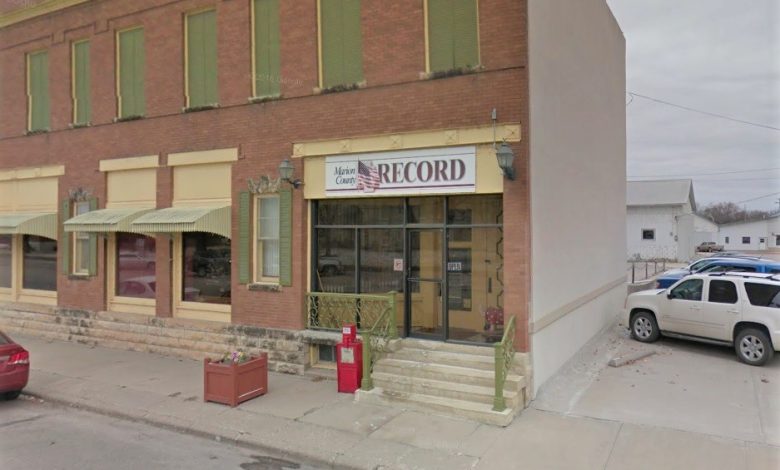
On Friday, August 11, 2023, Marion Police Chief Gideon Cody and city police executed a search warrant of the office of the The Marion County Record in Marion, Kansas, as well as the home of the owner and publisher.
The warrant indicates the allegation against the paper is “identity theft” and “unlawful acts concerning computers.”
As of the 2020 census, the population of the City of Marion was 1,922, located 50 miles north of Wichita. Marion is the county seat of Marion County, Kansas, population 11,823.
The 98-year-old co-publisher and co-owner of the paper, Joan Meyer, was also raided. She died the following day.
The raid and death of the paper’s co-owner has resulted in international attention, being reported by a myriad of news outlets: CNN, Fox News, USA Today, The Washington Post and even some overseas papers, like The Guardian (UK).
What Was Seized
Eric Meyer indicated the police took every computer, hard drive, server and even staff’s cell phones, raising doubts that the paper would be published the following week.
In the end, the staff of the newspaper was able get the edition onto the streets on time, using discarded computers and back-up files stored on DVDs, according to Meyer.
The headline read, “Seized…But Not Silenced.”
The paper’s equipment has now been returned.
According to a statement released by Marion County Prosecutor Joel Ensey, “On Monday, August 14, 2023, I reviewed in detail the warrant applications made Friday, August 11, 2023 to search various locations in Marion County including the office of the Marion County Record.”
The electronics have been sent by the paper to Kansas City, where a forensic specialist will examine the machines to ensure they were not tampered with.
Reasons for the Raid
The search warrant was signed by Marion County District Court Magistrate Judge Laura Viar and authorizes to seize, “Documents and records pertaining to Kari Newell.”
Meyer wrote in a recent article, “Marion restaurateur Kari Newell went before the city council Monday to angrily — and falsely — accuse the Record of illegally obtaining drunken-driving information about her and supplying it to a council member. The information actually was provided by a source who contacted the Record via social media and independently sent the material to both the newspaper and the council member.”
No story about Newell’s driving record was ever published.
As of press time, the affidavit, which should provide more details as to the basis for the warrant, has not been released. County prosecutor Ensey indicated in his statement, “The affidavits, which I am asking the court to release, established probable cause to believe that an employee of the newspaper may have committed…Unlawful Acts Concerning Computers. Upon further review however, I have come to the conclusion that insufficient evidence exists to establish a legally sufficient nexus between this alleged crime and the places searched and the items seized.”
The federal Privacy Protection Act, 42 U.S.C. §§ 2000aa-2000aa-12, protects journalists from most searches of newsrooms by federal and state law enforcement officials. The Marion Police Department noted on Facebook, “It is true that in most cases, it requires police to use subpoenas, rather than search warrants, to search the premises of journalists unless they themselves are suspects in the offense that is the subject of the search.”
Cognizant of recent criticism of the raid, the Facebook post also said, “I believe when the rest of the story is available to the public, the judicial system that is being questioned will be vindicated.”
Public Reaction
More than 30 news outlets and organizations devoted to freedom of the press were quick to condemn the raid.
A letter sent to Chief Cody by the Reporters Committee for Freedom of the Press stated, in part, “Newsroom searches and seizures are among the most intrusive actions law enforcement can take with respect to the free press, and the most potentially suppressive of free speech by the press and the public.”
The letter also noted, “Your department’s seizure of this equipment has substantially interfered with the Record’s First Amendment-protected news gathering in this instance, and the department’s actions risk chilling the free flow of information in the public interest more broadly, including by dissuading sources from speaking to the Record and other Kansas news media in the future.”
Attorney Max Kautsch serves as the legal hotline attorney for the Kansas Press Association and the Kansas Association of Broadcasters, is president of the Kansas Coalition for Open Government, and is an adjunct professor at the University Kansas School of Law. Kautsch is also hotline counsel to both the Nebraska Press Association and the Nebraska Broadcasters Association. He told FJN, “A democracy teeters on the brink when government officials use, or attempt to use, their authority to control information disseminated to its constituents. Under the First Amendment, the press in this country has the right to gather and report the news free from government interference. Without such protections, the news media would be reluctant or unable to give voters the information they need to cast their ballot in their own best interest, thereby thwarting journalists’ democratic function of checking government authority. Now that the search warrant has been withdrawn, there is hope that the government officials involved have a better understanding of the First Amendment. But questions remain, such as why the judge signed off on the search warrant in the first place. Journalists worldwide look forward to the prompt disclosure of that information so the public can further evaluate the extent to which errors were made.”