SENDD Looks To Use County Authority To Purchase Property
By Gordon Hopkins
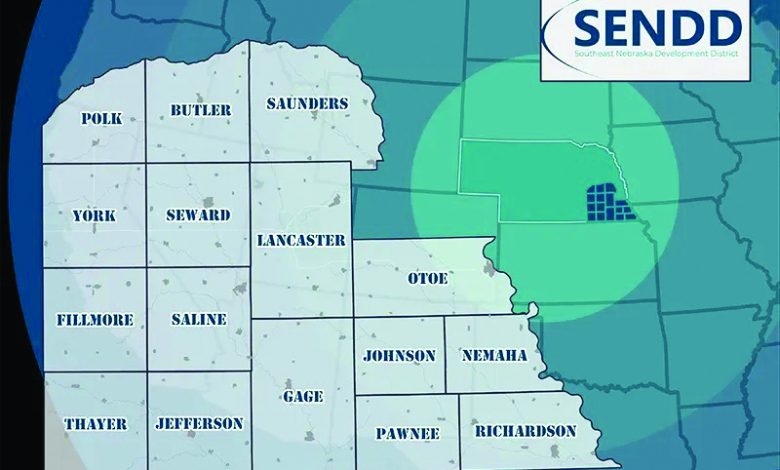
An interlocal agreement with counties would allow SENDD (Southeast Nebraska Development District) to form a 501(c)(3) and hold property. As of press time, 11 of the 16 counties in the SENDD district have signed such agreements. Gage County has signed on. Jefferson County is still considering the matter.
SENDD is a voluntary association of counties and municipalities, formed under the Nebraska Interlocal Cooperation Act, with a focus in community, economic, and housing development that identifies common problems.
Reason for the Agreement
Currently, SENDD is unable by law to purchase property for development. The new agreement would allow SENDD to purchase property using the authority of the counties.
Jefferson County Attorney Joseph Casson explained the proposal to commissioners at a meeting on Tuesday, January 13, 2026, “What I understand is being proposed is to accommodate a development opportunity that I think SENDD sees that’s available, but they don’t have the power to do it on their own. And it covers the whole district, and so they want to act independently, within the whole district, rather than partnering with each county to do projects within that county.”
According to Casson, SENDD is interested in “acquiring rural homes that are empty and abandoned and moving them to where they’re needed.”
“They want to bypass dealing with the counties individually,” said Casson. “By changing their bylaws to be able to own and sell real estate, they can then embark on this project that I understand they’re interested in pursuing.”
“They’re trying to, I guess I’d call it, exploit a loophole, “Casson explained, “ If you look at their enabling legislation, nowhere in there does it give them the authority to own and sell real estate. So that’s real simple. No, you can’t do that. And just changing your bylaws doesn’t give you that authority because the legislature didn’t give it in the first place. But what they’re adding to this is, we have an interlocal agreement with them, and each county has an interlocal agreement with SENDD, and what they’re putting in that interlocal agreement is, I’ll call a grant of authority to buy and sell real estate.”
Potential Downside
While the benefit to giving SENDD the opportunity to move homes to where they are needed is clear, Casson also discussed a potential downside, “Now, we have a representative on the SENDD board, so it’s not like our group of counties are being left out of the loop or having anything to say, because theoretically, our group of counties are running this project. So, if the group of counties agree this is something that benefits the district, then I guess we’re all behind doing that, because it’s not like it’s an independent agency that we have no control over. But we only have one vote. So, if the other counties agree on a project by a majority vote, then we’re stuck with whatever they come up with.”
Is It Legal?
One of the concerns Casson has is that the agreement is not for a specific project, “I question whether this is legal, but at the same time, these acts say that they should be liberally construed, and if there is a public interest in what they’re doing, you can probably justify what they’re doing. Except, if you go back to what was intended, an interlocal agreement typically is for a specific purpose. And so, if we had a project that we wanted to embark upon with SENDD, that we wanted to share our joint authority to accomplish that that project, I could see maybe somehow that that working, because we’re working in concert on this project, but this interlocal agreement is not to any particular project. It just has to do with our relationship with SENDD generally.”
“My belief is that this legislation was to create an entity that worked with the counties on projects. Now they want to deviate from that and have their own projects,” said Casson. “What I would prefer is that they go to the legislature and the legislature approve this.”
However, Casson also said that if the other counties all agreed to sign on, then Jefferson County should as well, “Each county has a representative on the board. And if, collectively, they think this is a good idea, then I can justify it legally, but it’s really thin.”
“So, it’s a legal question. Whether or not they should do it is a policy question, which is what you (the commissioner) decide, and that’s part of what I think all of the counties within the development district need to be discussing,” said Casson. “What I would prefer to see is that the representatives from each one of the counties discuss whether or not this is a good policy to have, then that representative can come to their full board and say, my recommendation is that we should do this, because it would be beneficial to the whole district.”
What Happens Next?
The matter was tabled until a subsequent meeting on Tuesday, January 27, when Tom Bliss, SENDD Executive Director, made the case for the agreement, “Housing development isn’t taking place in rural communities. So, what we’ve discovered is SENDD and our affiliates are the only ones doing that, it seems. So, we decided to become take on a little bit more aggressive approach to that.”
Per Bliss, creating a 501(c)(3) and having the ability to purchase property would allow SENDD “to pursue state and federal grants and foundation grants that we’re not currently eligible to pursue.”
Bliss said, “What we’d like to do is be able to serve as an umbrella 501(c)(3) for all the communities across our region that may not have a local foundation or a local 501(c)(3) in which to pass money through.”
In additional, Attorney Brad Roth of McHenry Haszard Law, said he had “Spent time with the League of Municipalities in Lincoln, their legal staff, making sure that felt everything that we were proposing was legally appropriate. And they confirmed on numerous occasions that what we’ve done was.”
Commissioner Danielle Schwab, who also serves on the SENDD board, moved to table the decision once again for further consideration as she expressed concern with giving authority to SENDD. The matter will come up again at the meeting on Tuesday, February 10, 2026.