Sensory Rooms In Schools Explained
By Gordon Hopkins
There was a time when students with special needs such as autism were simply removed from classrooms, citing “behavioral problems.” However, over the decades, various state and federal laws, such as the No Child Left Behind Act of 2001, have been enacted to ensure all children receive an education. This does mean that educators require specialized tools for special education, or “SPED” students.
One of those tools is called a sensory room.
Fairbury Public Schools (FPS) has sensory rooms in each level of school, Central Elementary, Jefferson Intermediary and Junior-Senior High School.
FJN contacted FPS Psychologist Dr. Jill Timmons and asked about sensory rooms.
“The sensory rooms in Fairbury Public Schools are spaces designed to promote calm, support sensory integration and provide a therapeutic setting. Education research shows that sensory rooms at school can benefit all kids, but especially kids with autism, sensory processing disorder, anxiety, ADHD or other special needs,” Timmons explained. “At FPS, we have a sensory room in each of the three main buildings and they are utilized by a variety of students multiple times throughout the day. Students who utilize the sensory room have plans for how to utilize them that are developed in collaborating with our occupational therapist. Students also can (and often do) request to use the sensory room to take a break or as a reward for working through a difficult task.”
There are other places in the schools that serve a similar function.
“We also have areas in some classrooms that serve a similar, but not quite the same, purpose. These are areas where students can go to self-regulate. Self-regulation is the ability to manage emotions and behavior in accordance with the demands of the situation. It includes being able to resist highly emotional reactions to upsetting stimuli, to calm yourself down when you get upset, to adjust to a change in expectations, and to handle frustration without an outburst. Often students with special needs struggle to self-regulate. In these spaces, students are taught self-regulation strategies by the special education teacher, counselor or school psychologist and apply those self-regulation strategies in that area of the classroom. This allows students to feel an overwhelming feeling but go to an area in the classroom where they can apply the strategies learned, manage the feeling, then return to learning,” said Timmons. “At Central, we added a sensory pathway for students to utilize throughout the day. Tip toeing on flowers, balancing on a snake, jumping on logs, wall pushes, spinning in place, walking heel toe, and reaching for the stars, are a few of the activities students can participate in as they make their way through the sensory path. Again, the education research shows that these kinds of activities offer all students an opportunity to self-regulate, organize their bodies and prepare themselves to focus when they go back to their classrooms. In addition, sensory pathways can also help students build strength, balance, hand-eye coordination, body and spatial awareness, grade movement (impulse control) and visual-motor skills.”
Patty Smith, Principal of Central Elementary, told FJN the school is looking into adding a second path, noting that the path is used ‘daily.’
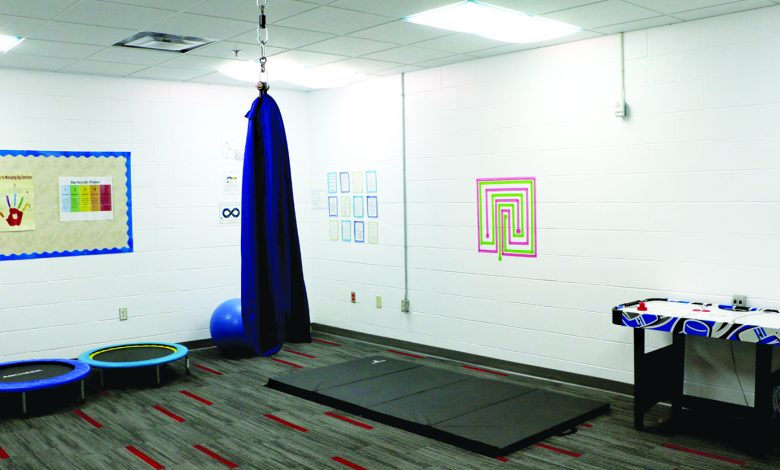
FJN was allowed to examine the rooms, which was stocked with various items for physical and mental activities, such as swings, trampolines and games.
A sensory room is different from a de-escalation room, sometimes referred to as a time-out room or seclusion room. The purpose of such a room is to manage physical and emotional outbursts by providing a student a place away from other students, giving the child a chance to calm down, avoiding the possibility that a student may harm himself or herself or another child. FJN recently published a story on de-escalation rooms in use at FPS.
Dr. Timmons explained the distinction, “Sometimes students have disabilities that can manifest in unsafe physical behaviors that put their safety at risk or the safety of others at risk. Our staff recognize the behavior is rooted in the student’s disability and therefore use positive behavior interventions throughout the day to minimize the possibility of a student expressing his/her needs through unsafe externalizing behaviors. At times, even when positive behavior interventions are employed, a student does present with physically unsafe behavior that compromises their safety or the safety of others. This happens rarely, but when it does, the student is taken to a safe de-escalation space within the building. This is a different area than a sensory room, because the rooms serve different purposes. De-escalation rooms are areas free from items that might be used to injure oneself or another. The space also provides the student with privacy from other students while the student is de-escalating. When the de-escalation space is used, a student is always under the direct supervision of an adult who is providing supportive verbal prompts to guide the student to safe behavior.”