Water Sourcing Report Released
By Gordon Hopkins
Pumping water from a proposed wellfield approximately four miles south of Daykin is expected to have only a minor impact on nearby irrigation wells.
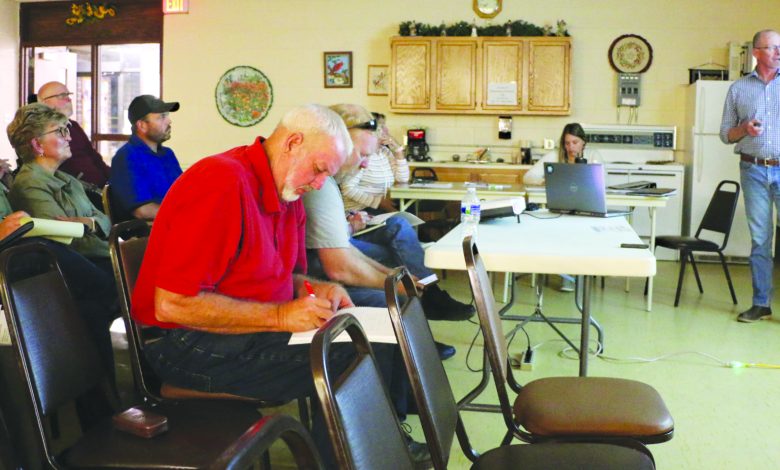
That is the conclusion of a groundwater model report that was presented to the public at a meeting the evening of Tuesday, September 27, 2022, at the Community Building in the Fairbury City Park. The report was created by LRE (Leonard Rice Engineering) Water, an engineering consultant based in Denver, Colorado, in support of the Fairbury water sourcing project.
Approximately 50 people were in attendance, including some local officials, such as Fairbury Mayor Spencer Brown and Jefferson County Commissioner Gale Pohlmann. The meeting lasted almost two hours.
The Little Blue Valley Water Systems’ (LBVWS) Water Sourcing Project remains controversial, despite attempts by the LBVWS to assure landowners the project will not severely impact local irrigation wells. To that end, the City of Fairbury hired LRE Water as an independent third party to provide a groundwater model to determine impacts to any nearby wells.
The report concluded that, “The proposed wellfield, if constructed, would only reduce aquifer discharge to waterways by approximately four percent compared to ambient pre-development conditions.”
The report also noted, “The proposed LBVWS’s wellfield pumping is not expected to substantially impact the production capacity of nearby wells, assuming a threshold 15 percent reduction in available aquifer head.”
Nitrates
The purpose of the Water Sourcing Project is to locate a new, lower-nitrate water source for both the Little Blue NRD (Natural Resources District) and the City of Fairbury. In July, 2021, the city entered into an inter-local agreement with Little Blue NRD to cost share in a project to identify a new water source with nitrates ranging in the 0-3ppm (parts per million), under the LBVWS entity. There are four board members in that entity, two of them representing the City of Fairbury, and two of them representing Little Blue NRD. Those board members are: Scott Nelson, General Manager – Little Blue NRD; Kevin Orvis, Project Manager – Little Blue NRD; Mary Renn, Project Manager, City of Fairbury; Erin Reimer, City Clerk, City of Fairbury.
Renn is an interim member of the board and replaces former city administrator Jacob Matthews.
Fairbury currently relies on the East Wells and Crystal Springs to provide water to the public. Both the East Wells and Crystal Springs have consistently tested in the higher range for nitrates, meaning greater than seven ppm (parts per million) but less than 10 ppm, over the past several years. While the overall water supply’s average nitrate levels have not reached above 10 ppm, over the years, one individual well has. In quarterly measurements of nitrate levels since 2015, well three has consistently higher levels of nitrates than the others, having reached 10.3 ppm in the third quarter of 2018, 10.4 ppm in the fourth quarter of 2018 and 10.3 ppm in the second quarter of 2021.
It was noted at the meeting that the model did not include nitrate trends or projected levels. The purpose of the model was strictly to determine the impact of the proposed wellfield on water levels.
“It wasn’t in our current project scope to do any of that type of modeling,” said David Hume, Senior Project Manager and Vice President of Midwest Operations for LRE. “That’s something that needs to be done as a separate project.”
A group of more than 60 landowners and residents calling themselves the Jefferson County Water Rights Coalition has expressed a number of concerns about the project. In a handout presented at the meeting, the coalition wrote, “Nitrate levels in the area are already rising, with no guarantee that they will remain at a safe level. The residents and farmers have kept records of their own through the decades, documenting rising nitrate levels in the area immediately surrounding the well field. The LBNRD has historically documented rising nitrate levels throughout the district, including irrigation wells within a half-mile of the test wells with nitrate levels exceeding 8ppm in 2012. Testing submitted this summer to state labs by local landowners found 6 wells over 9 ppm within a mile of the project site.”
Aquifer Recharge
The amount of water expected to be pumped from the new wellfield is approximately a million gallons per day. When water is removed from the aquifer, it is “recharged” primarily by precipitation. If water extracted is greater than the recharge, then the water level will drop.
It was pointed out in the meeting out y several in attendance that Nebraska has been experiencing drier than average weather for some time.
David Endorf, a member of the Water Rights Coalition, sent an email to members of the LBVWS board, “In my opinion, this study is not complete without serious review by LBNRD and LRE of the fall well readings and pumpage reports from the irrigators in the area closest to the proposed site. The neighboring wells were measured for static water levels before the February/March 2022 test pumping. This becomes an important baseline for checking the static levels in these same wells now, and on a weekly or bi-weekly basis, for the next several months. This was a dry year with 6-7 inches below normal rainfall for the calendar year. The static water levels are low now but will slowly be expected to recharge over the next 6-8 months. By closely monitoring the test wells also, during this time frame, valuable information as to the effect of neighboring wells on the test wells can be obtained. Also, actual measured information about the ability of this sand-with-clay-strips aquifer to recharge will be valuable. The fact that this aquifer cannot and will not have significant recharge from the South is critically important.”
Another landowner, Tobin Hoffman, raised another point at the meeting, “When the guy running a pivot up on top of the surface, some of the water’s going back down. You’re going to be taken from there and taking it miles and miles and miles away, where it’s not going to have a chance to go back down.”
Water Treatment Plant
The alternative to finding a new source of water is the build a water treatment plant to reduce nitrates from the locate water supply. This is the solution favored by a number of landowners in the Water Rights Coalition.
Project Manager Mary Renn has indicated previously that one reason for not building a treatment plant is cost “Based on literature values for treatment of constructing a nitrate plant (without going to bid) based upon the quantity of water the City of Fairbury and its outlying customers currently use will run approximately $10,000,000. In addition to the initial cost of construction, there is an on-going annual cost to maintain the plant and dispose of the nitrates estimated at approximately $350,000-$500,000 per year. The cost of a nitrate plant and maintenance thereof will likely result in a higher user (customer) cost as compared to securing a new water source. In the event treatment were ever needed, a larger customer base coupled with a higher water quality to begin with will lower the operation and maintenance costs.”
Renn also pointed out, “The new well site would not be classified as ground water under the influence of surface water and the treatment requirements are less restrictive.”
Next Steps
The report was scheduled to be presented to the Fairbury City Council Tuesday evening, October 4, and to the LBNRD Board of Directors on October 11. Both boards will have to approve advancing the project before it can move forward.
Nelson told attendees, “No decisions are going to be made for quite some time.