Back to the Moon
By Gordon Hopkins
On July 20, 1969, human beings walked on another world for the very first time when the Apollo 11 spacecraft touched town on the moon. The mission launched from the Kennedy Space Flight Center in Florida via the Saturn V Rocket on July 16 and safely returned to Earth on July 24, 1969. Astronauts onboard included Neil A. Armstrong, commander; Michael Collins, Command Module pilot; and Edwin E. “Buzz” Aldrin, Jr., Lunar Module pilot.
I was too young at the time to understand the importance of what was happening. It was December 14, 1972 when the crew of Apollo 17, the last of the Apollo lunar missions, departed the moon.
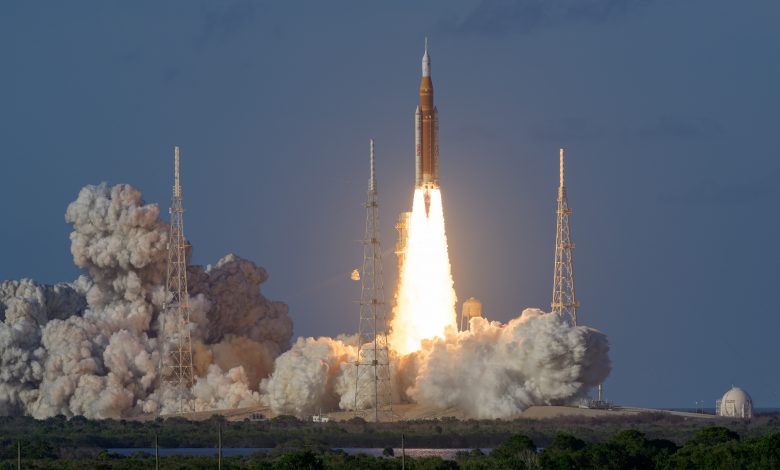
More than half a century later, the human species is once again setting out for our closest celestial neighbor.
Over the course of about 10 days, the Artemis II will orbit Earth twice before going around the far side of the moon. The crew will not be landing on the moon. Instead, the point of this mission is to prepare for a possible lunar landing by 2028.
You can’t take that “one step for mankind” without taking a whole lot of other steps first.
That’s how the Apollo moon landing worked. People tend to forget about Apollo 8. In December of 1968, Apollo 8 was the first crewed spacecraft to leave Earth’s gravitational sphere of influence and was the first manned spaceflight to reach the Moon. They didn’t land on the moon. The lunar lander wasn’t ready yet. Astronauts Frank Borman, Jim Lovell and William Anders undertook that first necessary step so that Neil Armstrong could take his.
The big question I have is this: does anyone really care? Yes, the mission is getting some news coverage, but is it being drowned out by all the reporting of the war and the upcoming election and the general political outrage that seems to plague our country? Inevitable, I suppose. You can’t postpone space missions for a slow news day.
Frankly, it is a little sad how blasé we have become about something like this. While I was too young to be entranced by the Apollo mission, as the rest of the world was, I certainly remember the Space Shuttle missions. In the beginning, every launch was an event. I couldn’t take my eyes off the TV screen as the camera focused on the massive spaceship awaiting countdown while some voiceover discussed the minutia of space travel.
I also remember when the launched became so routine that it was like an airplane taking off for the East Coast. That was the goal of the Space Shuttle program, of course. To create a fleet of spacecraft that could make travel into orbit routine, just like air travel, which was also once a spectacle before it became commonplace. Unfortunately, it also meant that, soon, the only time a Space Shuttle flight was mentioned in the news was when something terrible happened.
We no longer have the shared experience of sitting around the TV, the whole country watching the same channel as some amazing, world-changing event unfolds. Now, everybody only knows what shows up in the social media feed, which is decided by some incomprehensible algorithm. Perhaps the real reason this newest space mission isn’t garnering the same sort of excitement as those in the past is that a lot of people just don’t know about it. They know what Zendaya (barely) wore to the Oscars but not that the human race is headed back to the moon.
Well, I’m watching and I know it is a big deal.