Governor Signs Controversial Water Management Legislation
By Gordon Hopkins
Wednesday, April 20, 2022, saw the adjournment of the Nebraska Legislature. Although a short session, a number of significant bills were passed. Among them were two controversial water management bills anticipated to cost $700 million.
On Monday, April 18, Governor Pete Ricketts hosted bill signings for LB (Legislative Bill) 1015 and LB 1023e at the State Capitol. LB 1015 authorizes construction of a canal and reservoir system that Ricketts says is needed to protect South Platte River water flowing into Nebraska from Colorado. LB 1023e approves water projects put forward by the Legislature’s Statewide Tourism and Recreational Water Access and Resource Sustainability (STAR WARS) Committee.
“Today, we enacted two key laws to strengthen Nebraska’s water resources,” said Governor Ricketts. “LB 1015 helps protect the South Platte River water we depend on for drinking water, agricultural irrigation, and to nourish our natural environment. LB 1023e makes strategic investments to develop our water resources. This will create recreational opportunities for Nebraska’s families and grow tourism in our state. Thanks to Senators for protecting and developing our water resources this session.”
STAR WARS
The STAR WARS Committee proposed a number of water projects that were approved in LB 1023e, including:
• Creation of a 3,600-acre reservoir between Lincoln and Omaha
• Construction of a new marina at Lake McConaughy
• Construction of an event center and lodge at Niobrara State Park
• A major marina expansion at Lewis and Clark Lake
Ricketts said, “Water is our most important natural resource after our people.”
South Platte River Compact
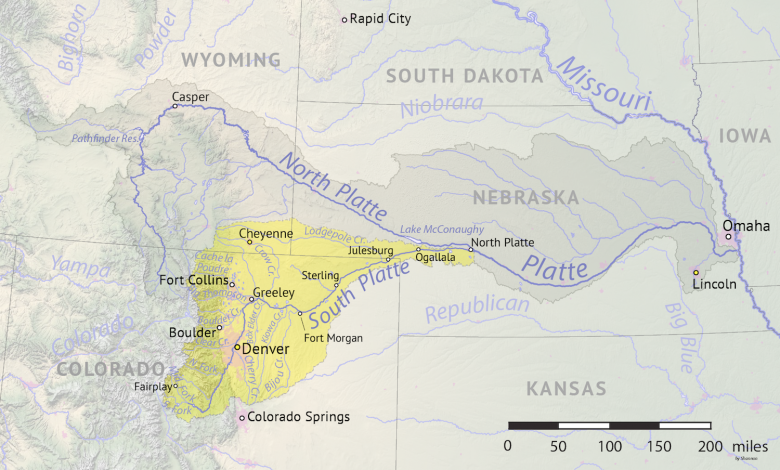
Governor Ricketts first announced plans to build a canal in Colorado at a press conference on January 10, 2022. The Governor stated at that time that Nebraska intends to take this action to protect its entitlements of South Platte River water by constructing a major canal in parts of Colorado and southwest Nebraska. The project, authorized under the South Platte River Compact, will support multiple uses including irrigation, power production, and municipal water supplies.
Nebraska State Senator Tom Brandt (District 32) was on the STAR WARS Committee, though he told FJN he knew nothing about the Colorado water rights issue at the time. FJN spoke to Brandt the day after Ricketts made his announcement in January, “And he had a project, unbeknownst to anybody else, he announced yesterday. That’s a canal in Colorado. That’s a $500 million project. It’s really kind of interesting. It’s sort of like a Tom Clancy kind of a thing.”
“In 1923, they were building a canal from Julesburg, Colorado, (colloquially known as the ‘Perkins County Canal’ at the time the Compact was signed) into Nebraska, off the South Platte River, and they went broke,” explained Brandt. “So, flash forward almost 100 years and what’s happened is Colorado is desperately short of water. They’ve created hundreds of new water projects.”
“And basically, the governor’s pushing back. And the unique thing about that compact is, if what he said is true, and you’ll have to confirm this, Nebraska has the right of eminent domain in the state of Colorado to build that canal. We have to build 24 miles of canal to get that water to Nebraska. And then we would build a reservoir in southwest Nebraska to store the water to be used for irrigation purposes and recreation.”
The South Platte River Compact, first established in 1923, is an interstate compact between Colorado and Nebraska and also has congressional consent. This compact established a commission that would address appropriation of the South Platte River, which enters into territory of both Nebraska and Colorado.
The Compact divides the waters of the South Platte River, ensuring certain flows will be delivered to Nebraska at the state line near Julesburg, Colorado. Construction of the canal and storage system (colloquially known as the “Perkins County Canal” at the time the Compact was signed) along the Nebraska-Colorado border will preserve Nebraska’s sovereign right to its share of the South Platte River water into the future.
The Governor noted the emerging need to protect Nebraska’s South Platte River water supplies, which he indicates are being threatened by planned developments in Colorado. Funding for the project is included in the Governor’s proposed budget. Ricketts wrote in a column earlier this year, “Colorado is currently planning nearly 300 projects and over $10 billion of expenditures to ensure no ‘excess’ water leaves its state. This threatens to choke off the flow of water into Nebraska.”
“The Nebraska Department of Natural Resources (NeDNR)—working with the Attorney General’s Office, natural resources districts (NRDs), and public power districts in our state—has been vigilantly watching developments in Colorado. NeDNR estimates that Colorado’s plans, when fully implemented, will cause a nearly 90% reduction in flows coming into Nebraska from Colorado,” according to Ricketts. “This would dramatically impact Nebraskans. Colorado’s plans to siphon off water from the South Platte River would decrease agricultural water supplies and raise pumping costs for our residents. It would jeopardize municipal water supplies for Lincoln, Omaha, and other Platte River communities. The loss of water would threaten the cooling water supplies for Gerald Gentlemen Station, Nebraska’s largest electric generation facility. The decreased flow would also undercut our capacity to generate hydroelectric power in Nebraska. The reduction in water would almost surely increase costs and regulatory burdens for the State, our NRDs, and water users.”
Colorado Governor Jared Polis disputes Governor Ricketts’ version of his state’s actions. In a statement, Polis said, “Colorado has been in full compliance with the South Platte Compact for the 99 years the agreement has been in place, and water has not and is not being withheld from Nebraska. Recent comments from Governor Ricketts seem to reflect a misunderstanding of Colorado’s locally driven water planning process. Our collaborative basin roundtables are a way that grassroots ideas and recommendations for solutions to Colorado’s future water needs are brainstormed. These ideas should not be taken as formally approved projects that will be implemented and all are subject to major conversations including with Nebraska.”
However, Polis also warned, “We will continue to protect and aggressively assert Colorado’s rights under all existing water compacts.”
Polis said, “Colorado and Nebraska have long worked together on our interstate water issues because of Colorado’s privileged status as a headwaters state. However, any actual proposed project by Nebraska in Colorado would receive rigorous review to ensure it is in compliance with the Compact, private property rights, Colorado water law, and state and federal environmental obligations, as endangered species issues among others are of critical concern on the South Platte River. I look forward to a productive dialogue with Governor Ricketts on the important issues of water development and protection of our natural resources in both Colorado and Nebraska.”
Jefferson County Commissioners have expressed some concerns about the proposed projects, primarily about the amount of funds these projects will tie up for other infrastructure projects.