Governor’s Education Finance Plan Advances
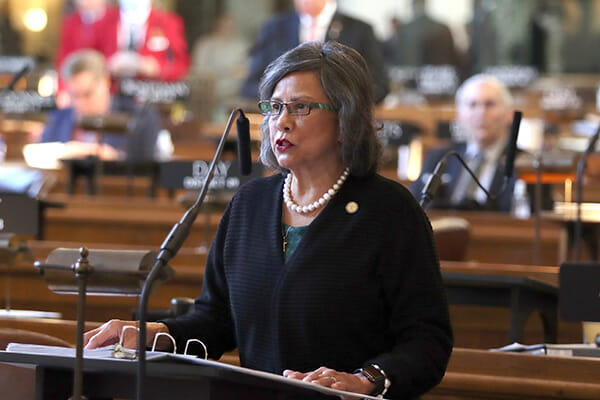
By Gordon Hopkins
A key part of Nebraska Governor Jim Pillen’s economic plan is moving forward. Like his predecessor, Pete Ricketts, Pillen intends to make tax reform a priority and a major element of that reform is public school funding.
On Tuesday, April 4, 2023, Governor Pillen’s education funding proposal, LB (Legislative Bill) 583, advanced through the first round of debate in a 39-3 vote, following two days of debate. It will still need to pass two more rounds of debate before it can be sent to the governor’s desk and be signed into law.
Introduced by Senator Rita Sanders of Bellevue at the request of Governor Pillen, LB 583 would increase state aid to public schools by $1,500 per student, beginning with school fiscal year 2023-24.
Diller-Odell Public Schools Superintendent Mike Meyerle is supportive. He told FJN, “It is something. All for the increase in SPED (Special Education) reimbursement.
“I am sure the bill is coming with trade-offs on other bills, but we need something more from the state regarding financial commitment,” said Meyerle. “A lot of people don’t like the $1500 per student. I don’t have a problem with it as it offers some consistency.”
LB 583 is just one of three bills that are part of the governor’s proposed school finance package. The others are LB 589, Adopt the School District Property Tax Limitation Act, and LB 681, change provisions relating to a fund and provide for transfers under the Tax Equity and Educational Opportunities Support Act. Dr. Chris Prososki, Superintendent of Southern Schools District, has expressed some concerns, particularly about LB 589, “LB 589 put an overall 3 percent revenue cap not only on property tax requests, but also on non-property tax revenue (e.g., state aid, insurance claims, and the sale of property). The only revenue excluded in LB 589 are special education funding and federal funding.”
According to the Open Sky Policy Institute, a public policy think tank and advocacy organization based in Nebraska, “For many districts, what the state would add to the revenue pie would be eaten away by the proposed revenue cap. At Superior Public Schools, a district of 370 students in Nuckolls County, the state would provide approximately $780,000 in new state aid but reduce what it could draw from property tax revenue by $775,000. A slight deficit remains even if a supermajority of local school board members voted to exceed its property tax asking authority by an additional 7 percent.”
A statement from Open Sky concluded, “Our school districts are already subject to both a spending limit and a levy limit. Further revenue restrictions, like those in LB 589, would significantly limit funding for school districts and make it more difficult to provide a quality education during a time of inflation, staffing shortages and increasingly complicated student needs.”
Dr. Prososki concurred. He told FJN, “Southern is currently 1 of the 86 equalized school districts (Beatrice is another equalized school district in the area) and there is no way LB 589 will work for any equalized school districts. The passage of LB 589 would require all equalized school district to make massive cuts to our current staff (Around 85 percent of school budgets are variable costs [e.g., staff salaries and benefits] and the other 15 percent are fixed costs [e.g., Building insurance, utilities, natural gas, fuel, Internet, etc.]). If LB 589 is approved, Southern would lose $439,396 in state aid next year. The equalized school districts educate roughly 70 percent of students in Nebraska and equalized school districts have more needs than resources based the current state aid formula (TEEOSA), hence why they receive state aid. It is also a huge oversight to include not only state aid under the 3 percent revenue cap, but also insurance claims, and the sale of property. If a school district has damage to a roof from a hail storm, why would you cap the insurance proceeds at 3 percent and make schools tax the local patrons for this revenue? In the same stand point, why would you penalize small school districts from saving costs and consolidating into one building and selling the old school buildings?”
Dr. Prososki added, “I feel that the governor’s heart is in the right place when it comes to the state providing more revenue to fund public education in Nebraska in an effort to lower taxes, but the governor and the state legislature does not understand the dire repercussions that will result if these proposals pass. The students in the great state of Nebraska deserve better than this.”