NextEra Responds to Proposed Wind Energy Regulations
By Gordon Hopkins
An energy company has responded to regulation changes proposed by a local attorney.
Jefferson County has now spent more than a year reviewing and revamping the zoning regulations that govern the placing of wind turbines in the county. A moratorium on new turbine construction was put in place to give the public he opportunity for input into the new regulations.
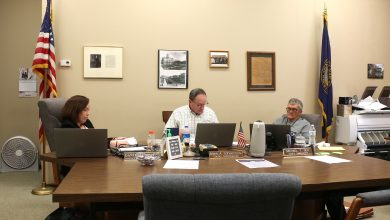
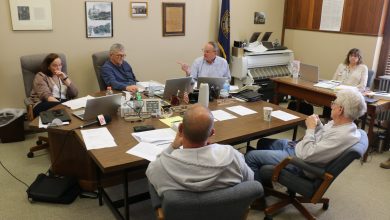
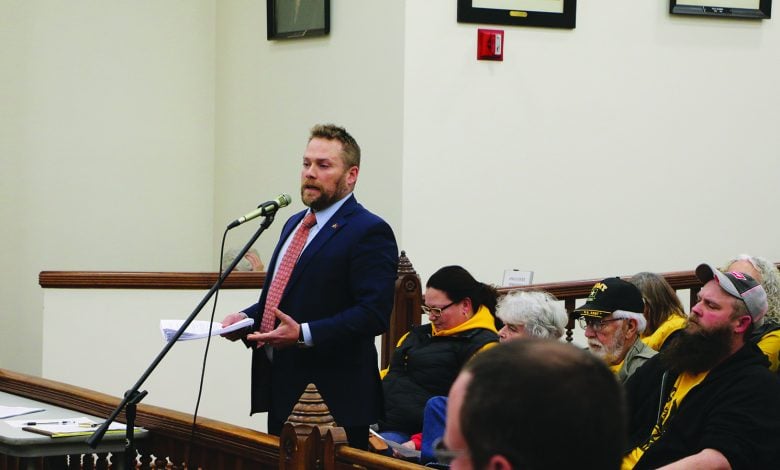
One member of the public is attorney Gregory Kratz, who presented the Planing and Zoning (P&Z) Committee with a package of recommended regulations at a meeting Thursday evening, January 12, 2023.
Kratz has not indicated if he was representing himself or a client at the meeting.
The regulations under consideration are setbacks, shadow flicker and decommissioning.
The current setback regulation under consideration reads, “Five (5) times the height of the total system from any occupied primary residence of a non-participating property owner, measured from an exterior wall of the occupied primary residence.”
“Height of the total system” is measured from the ground to the tip of a turbine blade when it is pointing straight up.
Kratz’s recommendation is, “One (1) mile (5,280 feet) from the turbine to any residence of a non-participating property owner, measured from the nearest exterior wall of the residence to the turbine.”
However, County Attorney Joseph Casson has expressed the opinion that even five times the height would, in effect, make it impractical to place a wind farm anywhere in Jefferson County. Casson spoke at a meeting last year and issued a warning to commissioners, suggesting the county could be in legal jeopardy if they make the regulations to restrictive, “And I’m saying to you, you can’t use the regulations to legislate wind towers out of existence in Jefferson County.”
NextEra Energy currently owns and operates one wind farm in Jefferson County, Steele Flats, and hopes to create another, Big Blue Wind, in Plymouth. NextEra has said any more than three times the height serves no purpose.
County Commissioners have emphasized the regulations are not for just one area or just one company, They will apply to the entire county.
FJN reached out to NextEra for a statement. A representative for the company responded, “The proposed wind turbine regulations presented at last week’s Jefferson County meeting by local Counsel Kratz, are incredibly restrictive – essentially making a new renewable energy project unfeasible in the county.
“The proposed regulations discount the property rights of the hundreds of landowners who are or want to participate in a wind farm in Jefferson County. Participating in a wind project is strictly voluntary and offers landowners a great way to diversify their income.”
Another issue in Kratz’s recommendations is sound, “No CWECS (Commercial Wind Energy Conversion System) shall exceed 40 dBA (decibels) during day time and 35 dBA at night (night hours are 10:00 p.m. to 7:00 a.m.) at the nearest residence of a nonparticipating property.”
Regarding sound levels, NextEra said, “In 2013, NextEra Energy Resources built the Steele Flats Wind Energy Center under a 60-decibel limit and a 1,320-foot setback, and there haven’t been any documented complaints. The 50-decibel limit the County Board adopted last August is twice as restrictive as the prior 60-decibel limit. Three-times the turbine height setback would be approximately 1,800 feet, which is also more restrictive than the existing setback. While the new County Board-adopted regulations – 50 decibels and three-times the turbine height – are more restrictive than what Steele Flats was based on, they recognize and balance the rights of participating property owners. The recently proposed wind turbine regulations find no such balance, nor do they find support in evidence of the public health, safety or welfare.”
The issue of sound coming from turbines was not on the agenda as commissioners have already voted on that regulation in 2022. At this time, commissioners have indicated they don’t have any plans to revisit the sound regulations, although Commissioner Michael Dux did say, “But we are open for discussion.”
Kratz disputes NextEra’s claim that his proposed regulations would make wind farms unfeasible, “The proposed regulations take into account the property rights of not only those wanting to put a turbine on their property but also the property rights of those who will be living next to them. It encourages land owners, wind energy development companies, and local residents to work together and ensures each have a say in how and where wind turbines are sited. It balances the property rights of all landowners and residents alike.
“On January 12, the Planning and Zoning Committee heard public comment for about two hours on the effect wind turbines have on the public health, safety and welfare. The vast majority of those comments sought stricter regulations in order to protect the public health, safety and welfare. My proposed regulations promote the public health, safety, and welfare while allowing landowners and residents the ability to determine the effect a wind turbine would have on their property.
“These proposed regulations would not make a new renewable energy project unfeasible. It just ensures those effected by a wind turbine project have a say in how and were one is built.”
Another P&Z meeting is scheduled for January 26, 2023, at 7:00 p.m.